


Pricing Your Home To Sell
Here are several steps to follow as well as some questions to answer before pricing your property. With these basic tips, your home will sell as fast as possible and for the highest possible price.
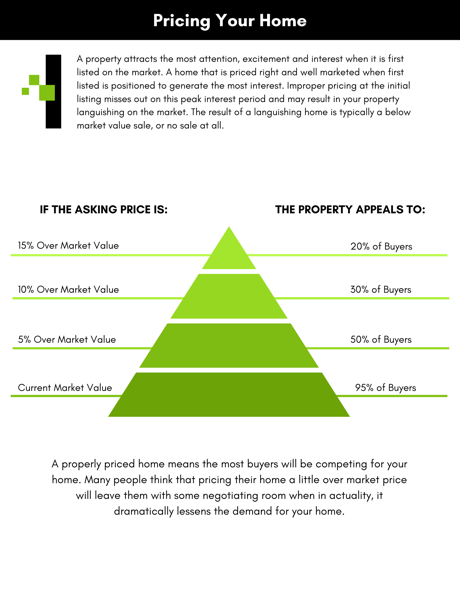
1. Your point of view does not matter at all to possible buyers. This is usually a extremely hard thing for sellers to accept. You have to distance yourself from the property. Potential buyers don’t really care how much you paid for your property, how much better your house is compared to the one that sold next door, or the amount you invested in the upgrades (hardwood flooring, paint, landscaping, etc).
2. Get a CMA (Comparative Market Analysis) from your Realtor. This should show you current sales, pending sales, current active listings, as well as properties that sold or expired in your neighborhood. This is the best way to pin down a realistic price range for your property. Pricing it correctly from the beginning is crucial. The majority of properties get the most showing activity when they’re first put on the market. Should you be priced too high, the perfect buyers won’t view your home. Don’t be fooled by a real estate agent who charms you with promises of an unrealistic selling price. Buying the listing of your home at a price over and above your CMA is common practice with a lot of Realtors. As soon as they have you in an agreement and your property isn’t showing, the agent will undoubtedly attempt to encourage you to reduce your asking price to what it should have been in the first place.
3. Be realistic with your time frame. If you decide to list your property at a value on the higher end of your price range, your property will likely sit on the market for an extended period of time. If you price on the lower end, you give yourself a far better chance of selling quickly.
4. Research your community by visiting open houses and try to be as impartial as you possibly can. What exactly does another home have that yours does not? Lot location, home size, as well as condition of the property will certainly come into play when buyers are trying to find a home. Much like when you purchased your home, potential buyers will certainly compare what else is available in a specific price range. If all asking prices were exactly the same, which house would you purchase? If the answer is not your own home, that's a problem.
5. What are current market conditions doing? How long are homes sitting on the market? Are prices increasing or decreasing? What time of year is your home going to be on the market? How are interest rates? Is the overall economy good or bad? Is it a buyers market or sellers market? How is the local job market growing? These are all questions that will determine how much buyers are willing to pay for homes or condos.
6. Offer incentives. Providing owner financing, home warranties, or flooring allowances are only a few incentives that may be offered to entice buyers. Another is offering to pay for settlement costs. A lot of buyers have the credit & income but don’t have the initial investment required to buy a home. Offering to pay closing costs might attract a number of buyers who otherwise could not afford to get into your home.
If you follow these steps and are unbiased in your assessments, you are going to price your home properly. This will result in selling it quickly and for the highest possible price.
In addition, don’t forget to take a look at our article about preparing your home to sell.